Why Your Hoses Keep Leaking – The Ultimate Showdown: Standard vs. Constant Tension Hose Clamps
In the world of fluid power and thermal management, the hose clamp is often the most overlooked component—yet it's frequently the culprit behind catastrophic system failures. Coolant loss, engine overheating, hydraulic pressure drops, and costly downtime often trace back not to a failed pump or radiator, but to a tiny clamp that was simply the wrong choice for the job.
When faced with the shelf of options, most buyers freeze: Do I grab the ubiquitous worm-drive standard clamp, or do I invest in the more sophisticated constant tension clamp? Today, we're breaking down the engineering battle using the DINSEN hose clamp as our benchmark for premium, reliable sealing.
Round 1: Mechanical Philosophy – Static Lock vs. Dynamic Compensation
A standard worm-drive clamp operates on a brutally simple principle: turn the screw, tighten the band, and lock the diameter. It is a "static lock" —once set, that diameter is fixed in time and space.
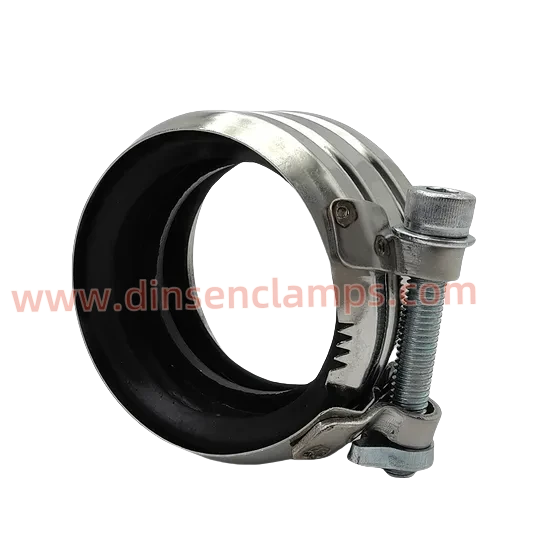
But physics doesn't care about your settings. Rubber hoses expand under heat, contract in freezing cold, and permanently deform over time under a phenomenon called "cold flow." This is where the DINSEN hose clamp (and the constant tension category it represents) completely separates itself. It incorporates a high-stress spring steel core that provides not a fixed diameter, but "dynamic compensation." As the hose swells or shrinks, the spring constantly adjusts to maintain the exact same radial clamping force—never too loose, never too tight.
Round 2: Real-World Pain Points – Frequent Leaks vs. Lifetime Sealing
The most common complaint from users of standard worm-drive hose clamps is heartbreakingly familiar: "I tightened it perfectly, but after one heat cycle on the highway, it was dripping." Why? Because standard clamps cannot compensate for thermal expansion and contraction. As the hose softens and compresses at high temperatures, the clamp's grip force plummets, and coolant or oil finds its way out.
Professional-grade constant tension clamps are engineered specifically to annihilate this pain point. For applications involving severe temperature swings, continuous vibration, or high-pressure pulses, DINSEN's constant tension products maintain a steady, unwavering radial force. They actively fight cold flow and resist vibration-induced loosening, delivering true lifecycle sealing—install it once, forget it forever.
Round 3: Installation & Risk – Overtorque Hazards vs. Self-Limiting Protection
Many seasoned mechanics have a bad habit: cranking standard clamps until they can't turn anymore. This leads to over-tightening—a disaster that cuts into the hose surface, destroys the reinforcement layer, and often strips the worm gear threads.
High-end constant tension clamps, like the DINSEN series, feature precisely calculated spring forces. They offer built-in overload protection—you simply cannot over-tighten them. The design delivers only the optimal clamping pressure required: enough to seal perfectly, but gentle enough to never damage the hose substrate. It's foolproof engineering.

The Bottom Line: Which One Belongs in Your System?
- Choose standard worm-drive clamps if your application is strictly static, low-pressure, or non-critical—think garden irrigation, gravity-fed drainage, or temporary field repairs on a budget. Choose constant tension clamps (and specifically, a trusted brand like DINSEN hose clamps) if your system involves:
- Automotive engine bays (extreme heat cycling)
- Heavy machinery hydraulic lines (high-frequency vibration)
- EV battery thermal management systems (rapid, extreme temperature deltas)
- Precision medical or analytical cooling loops (zero-tolerance for leaks)
In these demanding environments, constant tension isn't a luxury—it's an absolute necessity.
Still unsure which hose clamp fits your specific setup? Leaking issues driving you crazy?
👇 DM us with "SCENARIO + DIAMETER" – Our senior application engineers will provide you with a 1-on-1 hose clamp selection proposal to eliminate trial-and-error and save your budget.
-
Celebring China's National Day — Warmest Greetings from DINSENNewsOct.08,2026
-
Our Office Will Pause for the National Day WeekNewsSep.28,2026
-
Are Hose Clamps Stainless SteelNewsSep.22,2026
-
Invitation to the 140th Canton Fair 2026 DINSENNewsSep.15,2026
-
What Is a Characteristic of a Pipe ClampNewsSep.14,2026
-
T-Bolt vs Worm Gear Hose Clamp: Pressure Rating ComparisonNewsAug.24,2026
-
Kombi Kralle vs Standard Coupling: Differences & Use CasesNewsAug.20,2026