Rubber Gasket Materials for Pipe Couplings: EPDM, NBR, FKM and TPE Compared
Most पाइप युग्मन failures start with the gasket, not the steel. EPDM is the best all-round choice for water and sewage lines, NBR excels with oils and fuels, FKM (Viton) handles high heat and aggressive chemicals, and TPE offers a cost-effective option for light-duty, general-purpose repairs. Choosing the right rubber ring material can extend coupling service life by 3–5 times in demanding environments.
1. What Is a Pipe Coupling and Where Is It Used?
A pipe coupling joins two lengths of pipe, or repairs a damaged section, without threading, welding or flanging. In building drainage, municipal sewage, water supply and industrial pipework, couplings are the fastest way to connect dissimilar pipe materials — cast iron to PVC, clay to ductile iron, steel to HDPE — while allowing slight angular deflection and vibration absorption.
DINSEN supplies a full range of pipe coupling products, including Grip E couplings for construction, banded repair couplings, no-hub couplings और Cast Iron to PVC A/B type couplings, manufactured under an ISO 9001 quality system. If you are not sure which coupling type fits your project, start with our guide: How to Choose the Right Pipe Couplings?
2. Inside a CHA Coupling: Structure Breakdown
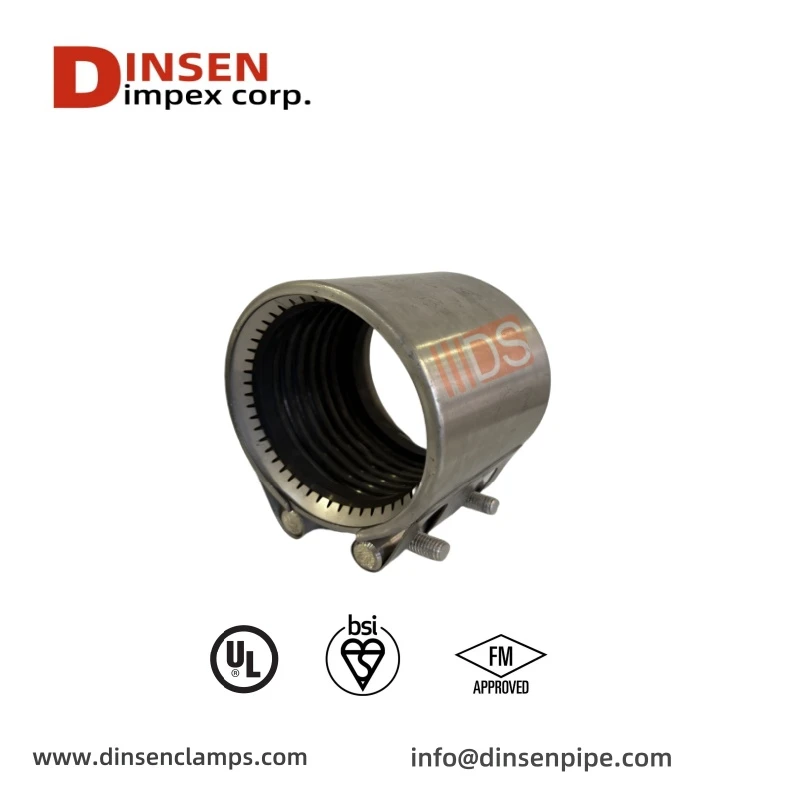
The DINSEN CHA Coupling is a shielded, banded coupling designed for joining and repairing drainage, waste and vent pipes. It has four core components:
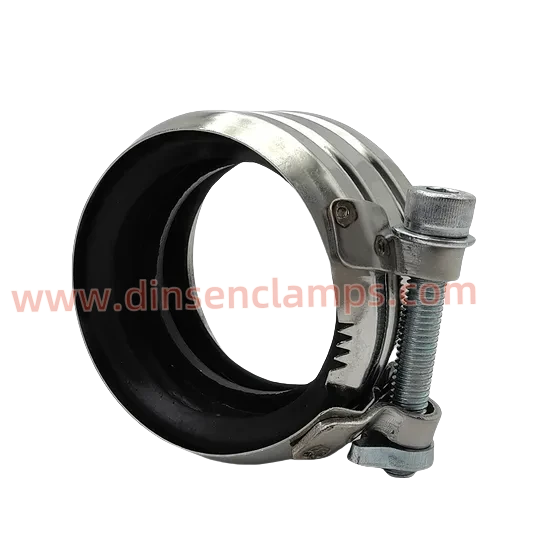
- Rubber gasket (sleeve) — the elastomeric body that wraps the pipe joint and creates the seal. Material options: EPDM, NBR, FKM, TPE (detailed below).
- Stainless steel band / shield — wraps the outside of the rubber sleeve, resists soil load and maintains compressive force. Typically SUS 304, SUS 316 on request.
- Bolts and nuts — clamp screws that draw the band tight. Stainless steel as standard; torque control during installation is critical (see our installation guide).
- Hose-clamp-style fastening strips — distribute clamping pressure evenly along the band so the seal stays uniform around the full circumference.
Steel decides the coupling's strength; the rubber gasket decides whether it leaks. That is why gasket material selection matters more than any other specification decision.
3. The Rubber Gasket: The Heart of the Seal
The gasket works by compression: when the bolts are tightened, the steel band squeezes the rubber sleeve against the pipe surface. The rubber must stay elastic across the system's temperature range, resist the chemicals carried in the pipe, and survive UV, ozone and soil exposure for years underground or in plant rooms. Standard gasket hardness is Shore A 60 ± 5, and material grades can be specified against EN 681-1 (elastomeric seals for water applications) or ASTM D2000 line call-outs.
4. Four Common Gasket Materials Compared
4.1 EPDM (Ethylene Propylene Diene Monomer)
Best for: water, sewage, steam-condensate, dilute acids and alkalis.
EPDM is the industry default for drainage and sewer couplings. It offers outstanding resistance to hot water, ozone, UV and weathering, and stays flexible from roughly -40°C to +120°C. Drinking-water-approved grades (WRAS, KTW) are available. Its one weakness: EPDM swells and degrades in contact with petroleum oils, fuels and greases — never specify it for fuel lines.
4.2 NBR (Nitrile Butadiene Rubber / Buna-N)
Best for: oils, diesel, hydraulic fluid, greases, animal and vegetable fats.
NBR is the go-to elastomer wherever the medium contains oil. It handles continuous temperatures from about -30°C to +100°C and offers strong abrasion resistance. Its weakness is the mirror image of EPDM's: poor ozone and UV resistance, so NBR-gasketed couplings for outdoor or buried service should always be fully shielded by the steel band.
4.3 FKM (Fluoroelastomer, commonly known by the trade name Viton)
Best for: high temperatures, fuels and solvents, aggressive chemicals, chemical-plant service.
FKM withstands continuous service up to about +200°C and resists a very wide spectrum of oils, fuels, solvents and many acids — a combination neither EPDM nor NBR can match. The trade-offs are cost (typically several times the price of EPDM or NBR) and poor performance in hot water, steam and some ketone solvents. Reserve FKM for applications that genuinely need its chemical and heat headroom.
4.4 TPE (Thermoplastic Elastomer)
Best for: light-duty and general-purpose repairs, budget-sensitive projects.
TPE behaves like rubber but processes like plastic: it is recyclable, economical and available in drinking-water-approved grades. Typical service range is about -30°C to +90°C, with moderate oil and chemical resistance. For standard drainage repair tasks it performs well, but for sustained high temperature, oil immersion or aggressive media, cross-linked elastomers (EPDM/NBR/FKM) are the safer specification.
5. Quick Comparison Table
Property | ईपीडीएम | एनबीआर | FKM (Viton) | TPE |
Service temperature | -40°C ~ +120°C | -30°C ~ +100°C | -20°C ~ +200°C | -30°C ~ +90°C |
Water / sewage | Excellent | Good | Fair (avoid steam) | Good |
Oils & fuels | Poor | Excellent | Excellent | Moderate |
Ozone / UV / weathering | Excellent | Poor | Very good | Fair |
Acids & chemicals | Good (dilute) | Limited | Excellent | Limited |
Drinking-water approval | WRAS / KTW grades | Limited | Rare | उपलब्ध |
Relative cost | Low | Low–Medium | High | Lowest |
Typical application | Drain, sewer, water main | Oil/fuel lines, plant rooms | Chemical & hot media | Light-duty repairs |
6. How to Choose the Right Gasket Material (3-Step Decision)
- Step 1 — Identify the medium. Water or sewage → EPDM. Any oil, fuel or fat → NBR. Solvents, acids or temperatures above 120°C → FKM. Non-critical general repair → TPE.
- Step 2 — Check the temperature envelope. Match the gasket's continuous service range against the pipeline's minimum and maximum temperatures, including steam sterilization or sun-exposed installations.
- Step 3 — Confirm approvals and total cost. For potable water, request WRAS/KTW certified grades; for buried service, pair EPDM with a stainless steel shield. A slightly more expensive gasket is almost always cheaper than a second excavation.
सामान्य प्रश्न
1. Can I use an EPDM gasket on a pipe carrying oil?
No. EPDM swells and deteriorates in petroleum oils and fuels. Use an NBR gasket for oil-based media, or FKM if temperatures are high or the oil contains aggressive additives.
2. Which gasket material is best for drinking water pipelines?
EPDM with WRAS or KTW certification is the most common choice for potable water couplings, combining long-term elasticity with hygienic approval. Certified TPE grades are also available for lighter-duty repairs.
3. What is the difference between NBR and EPDM rubber?
In one line: NBR resists oil but not weathering; EPDM resists weathering and water but not oil. For drainage and sewage choose EPDM; for fuel or lubricant lines choose NBR.
4. How long does a pipe coupling gasket last?
A correctly selected, correctly torqued gasket in a shielded coupling commonly lasts 20+ years in buried drainage service. Premature failure is almost always caused by medium-material mismatch, over-torque or under-shielding.
5. Can DINSEN supply couplings with custom gasket materials?
Yes. DINSEN produces CHA couplings and repair couplings with EPDM, NBR, FKM or TPE gaskets, with custom band materials (SUS 304/316) and sizes against customer drawings, under ISO 9001 quality control.
8. Get Expert Advice from DINSEN
Not sure which gasket material your project needs? Send us your medium, temperature range and pipe OD, and our engineering team will recommend the right CHA Coupling configuration within 24 hours. DINSEN manufactures hose clamps and pipe couplings for customers in 50+ countries — contact us for a free quote and sample support.
-
Stainless Steel Hose Clamp Installation Guide: Avoid LeaksसमाचारNov.04,2026
-
Day 4 at the 140th Canton FairसमाचारOct.26,2026
-
What Is a Characteristic of a Pipe Clamp? Key Features, Types & Buying GuideसमाचारOct.21,2026
-
Celebring China's National Day — Warmest Greetings from DINSENसमाचारOct.08,2026
-
Our Office Will Pause for the National Day WeekसमाचारSep.28,2026
-
Are Hose Clamps Stainless SteelसमाचारSep.22,2026
-
Invitation to the 140th Canton Fair 2026 DINSENसमाचारSep.15,2026