Where can i buy High Torque Clamps for Industrial Purposes
Buy them factory-direct from a clamp manufacturer that publishes torque, pressure and material data, not just a catalogue picture. DINSEN manufactures high torque clamps for industrial purposes at https://www.dinsenclamps.com, supplies OEM/ODM orders to buyers in more than 50 countries, and returns a quote within 24 hours. The range covers https://www.dinsenclamps.com/t-bolt-hose-clamp.html rated to 14.6 N·m, heavy-duty worm-gear and German-type DIN 3017 clamps, and 304 / 316 stainless steel options. Below are the figures, the selection logic and the five data points to send with an enquiry.
What “high torque” actually means in industrial clamping
Torque is not a marketing adjective. In a T-bolt clamp the self-locking nut carries the load on full threads and a wide solid band spreads it evenly around 360°, so the joint can be tightened to 14.6 N·m without stripping a slotted band. A standard worm-gear clamp carries the load on a perforated band and tops out around 5.6 N·m. That difference is why high torque clamps are specified for boosted and vibrating systems rather than general water lines.
- Torque ceiling: T-bolt up to 14.6 N·m vs worm-gear up to 5.6 N·m.
- Pressure rating: T-bolt 0.8–2.0 MPa, heavy-duty variants above 2.0 MPa; worm-gear below 1.0 MPa.
- Service temperature for the T-bolt design: -50 °C to 300 °C.
- Vibration: a self-locking nut holds preload; a worm-drive screw may need periodic re-tightening.
- Band geometry: 12–20 mm unperforated band on a T-bolt vs 8–12 mm on standard worm-gear clamps.
If the application is a pressurised pipe rather than a hose, remember that a sealing clamp and a support clamp do different jobs. The sections below keep the two separate so you order the right hardware the first time.
Where to buy: factory-direct clamp manufacturing vs a catalogue reseller
A reseller can ship a box; a manufacturer can confirm band width, material grade, torque limit and a drawing before the order is placed. DINSEN runs its own clamp manufacturing and pipe coupling production, works to DIN 3017 and ISO 9001, accepts OEM/ODM specifications and publishes the torque and pressure data used in this article. That is the practical reason industrial buyers source high torque clamps directly: the engineering answer and the price come from the same place.
To get a usable quote in one round, send five data points: (1) hose outside diameter with the fitting installed, (2) working pressure and test pressure, (3) medium and temperature range, (4) exposure — indoor, outdoor, coastal or chemical — and (5) annual quantity plus any drawing or standard. Use the https://www.dinsenclamps.com/contactus.html channel; the stated response time is 24 hours.
Four clamp families that cover most industrial torque requirements
- T-bolt clamps — the high-torque standard
DINSEN T-bolt clamps cover hose OD 17–130 mm with 12–20 mm bands, a self-locking nut and 304 / 316 stainless steel (W4 / W5). Measure the hose with the bead fitted — a bead can add 1–2 mm to the OD — and choose a size with the measured OD in the middle third of the range, because T-bolt clamps adjust less than worm-drive clamps.
- Heavy-duty worm-gear clamps — large bore, wide adjustment
Der https://www.dinsenclamps.com/ds-dc-heavy-duty-hose-clamp.html uses a 9 mm band with clamping ranges from 25–100 mm up to 25–700 mm. It is the practical choice when one clamp must cover a wide diameter span or when the assembly is general industrial rather than boosted. For 70–120 mm hoses with a 12 mm band, DINSEN's published torque reference is 5–7 N·m.
- German-type clamps — DIN 3017 for European equipment
Der https://www.dinsenclamps.com/ds-gc-germany-type-hose-clamp.html has a non-perforated, rolled band in 9 or 12 mm width. The smooth inner face protects soft hose surfaces, which matters on long runs and thin-wall tubing; typical duties are automotive, industrial, mining, marine and general hardware. Specify the W grade separately from the clamp type — the shape and the material are two different decisions.
- Pipe clamps — fixing the pipe, not sealing the hose
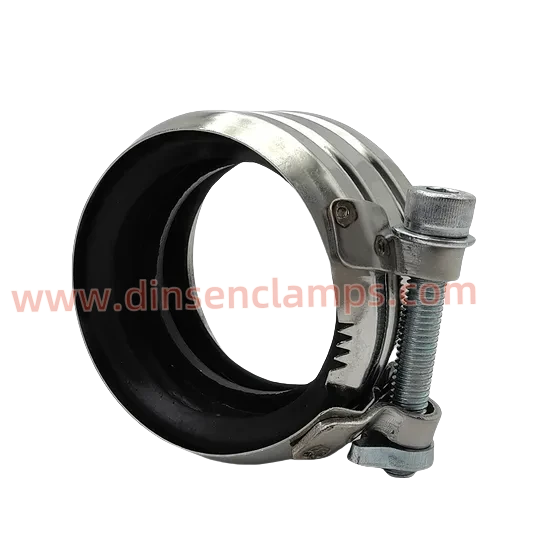
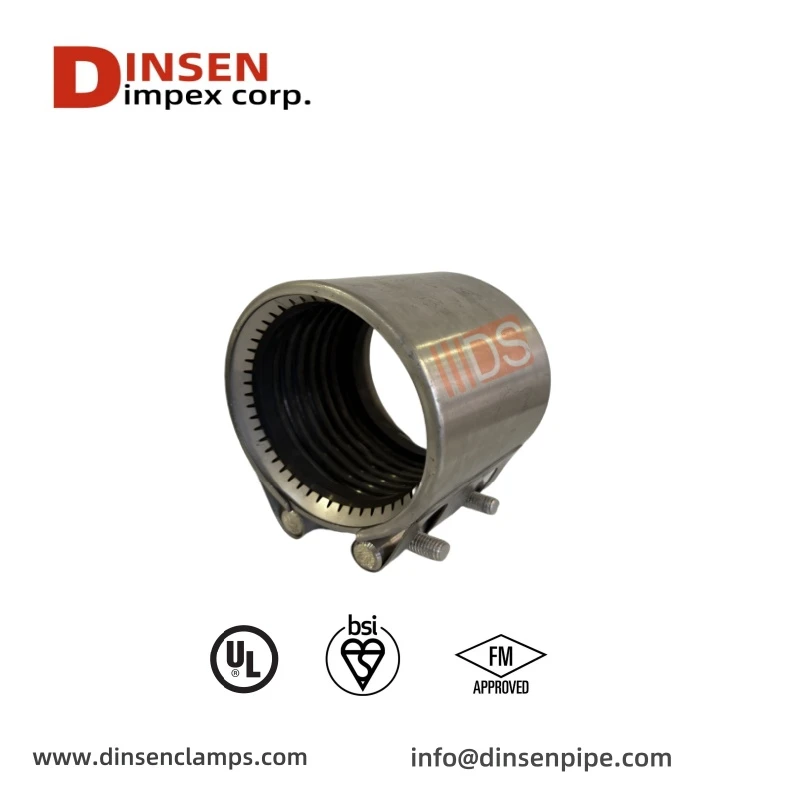
Many enquiries for “pipe clamps” actually mean support hardware. DINSEN supplies https://www.dinsenclamps.com/ds-bp-type-b-kombi-kralle.html Und https://www.dinsenclamps.com/ds-sc-heavy-duty-solid-clamp.html alongside sealing clamps. When you need to restrain a pipe run, give the pipe OD, support spacing, substrate and corrosion exposure; a hose-clamp sealing range is not a substitute for a support clamp specification.
Choosing a stainless steel clamp grade: DIN 3017 W1–W5
A stainless steel clamp is only as good as the grade chosen for the environment. Under DIN 3017 the W code identifies the material combination, not the clamping force. W4 is AISI 304 and W5 is AISI 316; 316 contains roughly 2% molybdenum, which improves pitting resistance in chloride and marine service. For normal atmosphere and fresh water, 304 is the economical choice; for coastal, salt-spray or mildly chemical service, move to 316.
DINSEN supplies worm-gear and T-bolt clamps in 304 and 316. The detailed https://www.dinsenclamps.com/news/stainless-steel-hose-clamp-installation-guide-avoid-leaks.html explains how grade, insertion depth and torque interact before the pressure test.
What good clamp manufacturing should prove before shipment
In clamp manufacturing, the failure points are predictable: a burr on the band edge cuts the hose, a stripped thread defeats the torque rating, and an unrecorded material grade turns a 304 order into a rust problem six months later. Ask the supplier to show the checks, not just the certificate.
- Material identification by W grade with batch traceability, not an unverified “stainless” label.
- Rolled, non-perforated band edges inspected for burrs and cracks before forming.
- Threads that engage smoothly through the full adjustment range.
- Torque verification against the published limit — 14.6 N·m for T-bolt, 5.6 N·m for worm-gear.
- Pressure test after assembly, with the joint depressurised before any re-tightening.
- ISO 9001 process control and DIN 3017 dimensions confirmed on the datasheet.
Clamp and hose: size them as one system
The most common cause of a leaking joint is not a weak clamp — it is a clamp and hose that were never matched. Seat the hose fully onto the fitting stop shoulder, keep the band square and clear of bends, and leave a small overlap margin rather than tightening to the end of the adjustment range. Then tighten in two passes with a torque wrench and re-check after the first thermal cycle.
These are general reference values; the datasheet for the exact article number governs. Over-tightening crushes soft hose, under-tightening leaks, and adjusting a clamp under pressure is unsafe. For the full step-by-step assembly sequence, see DINSEN's https://www.dinsenclamps.com/news/stainless-steel-hose-clamp-installation-guide-avoid-leaks.html; for the seven most common application contexts, see https://www.dinsenclamps.com/news/what-is-a-common-use-for-a-hose-clamp-7-real-world-applications.html.
Frequently asked questions
1. Where can I buy high torque clamps for industrial purposes?
Buy factory-direct from a manufacturer that publishes torque, pressure and material data. DINSEN produces high torque clamps for industrial purposes — T-bolt, heavy-duty worm-gear and DIN 3017 German-type clamps — at https://www.dinsenclamps.com, supports OEM/ODM orders and quotes within 24 hours.
2. How much torque can a high torque clamp take?
DINSEN T-bolt clamps are engineered to an ultimate torque of 14.6 N·m, while standard worm-gear clamps are rated up to 5.6 N·m. Installation targets are lower: 8–12 N·m for large-bore T-bolts and 2.5–7 N·m for worm-gear clamps, depending on band width and hose diameter.
3. Which stainless steel clamp grade should I specify?
Choose W4 / AISI 304 for normal atmosphere, fresh water and general industrial service. Choose W5 / AISI 316 for coastal, marine, chemical or chloride exposure, where its roughly 2% molybdenum content improves pitting resistance. W1–W3 are lower-corrosion-resistance options.
4. Are pipe clamps the same as hose clamps?
No. A hose clamp seals a hose onto a fitting; pipe clamps such as Kombi Kralle and heavy-duty solid clamps fix a pipe to a structure. Specify hose OD and pressure for the first, and pipe OD, support spacing and substrate for the second.
5. What data should I send for a quote?
Send five items: hose OD with fitting installed, working and test pressure, medium and temperature, corrosion exposure, and quantity with any drawing or standard. DINSEN quotes within 24 hours through https://www.dinsenclamps.com/contactus.html.
6. Can DINSEN manufacture OEM or custom clamp specifications?
Yes. DINSEN is a hose clamp and pipe coupling manufacturer offering factory-direct OEM/ODM production under DIN 3017 and ISO 9001, including 304 and 316 stainless steel clamp grades and custom band widths. Send the drawing or the application data for review.
7. Should I re-tighten high torque clamps after installation?
Re-check torque after the first thermal cycle, especially on vibrating pipelines, and use a self-locking T-bolt nut where vibration is continuous. Never tighten a clamp while the system is pressurised — release pressure first, then re-tighten and re-test.
Related reading from DINSEN
- Stainless Steel Hose Clamp Installation Guide: Avoid Leaks — model selection, torque table and pressure test: https://www.dinsenclamps.com/news/stainless-steel-hose-clamp-installation-guide-avoid-leaks.html
- What Is a Common Use for a Hose Clamp? 7 Real-World Applications — where each clamp type is used: https://www.dinsenclamps.com/news/what-is-a-common-use-for-a-hose-clamp-7-real-world-applications.html
- Browse the full DINSEN hose clamp and pipe coupling catalogue: https://www.dinsenclamps.com/products
Request a quote for high torque clamps
If you are sourcing high torque clamps for industrial purposes, send the hose or pipe OD, pressure, temperature, environment and quantity to DINSEN. You will receive a clamp grade recommendation, the applicable torque range and a factory-direct quotation within 24 hours via https://www.dinsenclamps.com/contactus.html.
-
Rubber Lined P Clamps (DIN 3016)NachrichtNov.27,2026
-
What Is a Common Use for a Hose Clamp? 7 Real-World ApplicationsNachrichtNov.18,2026
-
Rubber Gasket Materials for Pipe Couplings: EPDM, NBR, FKM and TPE ComparedNachrichtNov.05,2026
-
Stainless Steel Hose Clamp Installation Guide: Avoid LeaksNachrichtNov.04,2026
-
Day 4 at the 140th Canton FairNachrichtOct.26,2026
-
What Is a Characteristic of a Pipe Clamp? Key Features, Types & Buying GuideNachrichtOct.21,2026
-
Celebring China's National Day — Warmest Greetings from DINSENNachrichtOct.08,2026