
Will Stainless Steel Pipe Clamps React with Copper Pipes
In pipe installation, HVAC engineering, refrigeration systems, and everyday home repairs, we often face a crucial question: Will stainless steel pipe clamp react with copper pipe? This is not only essential knowledge for construction workers but also crucial for the long-term safety and stability of the entire piping system. Improper handling can lead to electrochemical corrosion in seemingly simple fasteners, causing copper pipe leaks and resulting in significant economic losses. This article will provide an in-depth answer to this core question from three perspectives: chemical reaction principles, engineering specifications, and product selection. It will also introduce the professional advantages of DINSEN stainless steel clamps in solving such application scenarios.
What happens when stainless steel comes into contact with copper?
Because stainless steel and copper have different electrode potentials. In humid air, tap water, seawater, or acidic media, contact between the two will form a galvanic cell: copper, with its higher potential, acts as the cathode and is protected; while stainless steel (especially 304 and 316) has a relatively lower potential. If it directly contacts a copper pipe, the copper pipe will become the anode, and its corrosion rate will be significantly accelerated. Specifically, this manifests as pitting corrosion and localized thinning of the copper pipe at the clamp contact surface, eventually leading to perforation and leakage.
Therefore, directly clamping stainless steel clamps onto copper pipes is considered a design flaw that should be avoided in engineering.
Will stainless steel pipe clamp react with copper pipe:
1. Use an insulating layer: Add a EPDM rubber gasket, PTFE tape, or insulating tape between the clamp and the copper pipe to physically block direct contact between the two metals, thereby cutting off the electron flow path for electrochemical corrosion.
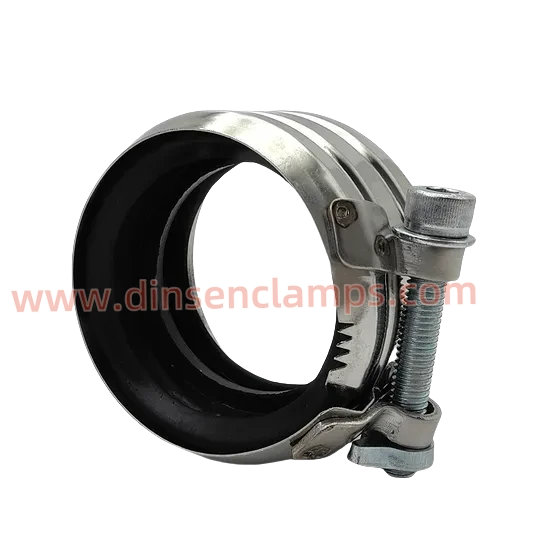
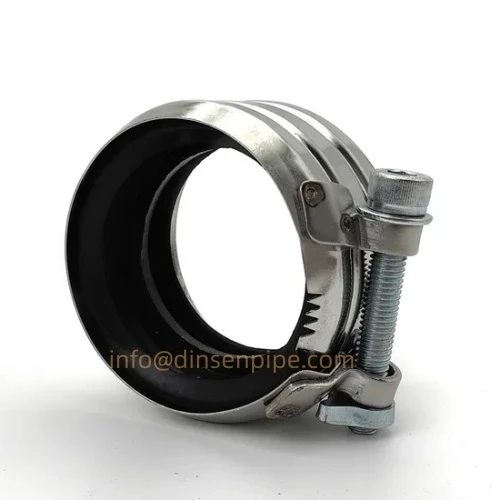
2. Choose lined professional clamps: Select stainless steel clamps with rubber or plastic linings on the inner wall. These products have an integrated insulation layer at the factory, making installation convenient and more reliable.
3. Control the operating environment: In absolutely dry, non-condensing indoor environments (such as inside certain electrical equipment or dry gas pipelines), galvanic corrosion cannot occur due to the lack of an electrolyte film, making the direct use of stainless steel clamps safe.
In dry environments, the risk of directly using stainless steel clamps to fix copper pipes is low; in humid, water-contaminated, or environments with large temperature differences, clamps with insulating linings or additional insulating layers must be used. In either case, choosing a reliable stainless steel clamp brand with clearly defined parameters is crucial.
If you have questions about specific application scenarios, please refer to the DINSEN stainless steel clamps manual or consult professional technical support to ensure that every pipe clamps is used with peace of mind.
-
How Can a Leaking DI Pipe be Repaired without Shutting it Off?VijestiApr.16,2026
-
What is the difference between 'Hose clamps' and 'Hose Clips'?VijestiApr.08,2026
-
DINSEN Powers Global Debut with Two Major Exhibitions – Strong Market EntryVijestiApr.02,2026
-
Best Suppliers of EPDM Rubber Gaskets Compliant with EN681VijestiApr.01,2026
-
What Metal is Used for Pipes in Plumbing in HousesVijestiMar.25,2026
-
Saudi Aramco cuts oil supply to Asia Amid Strait of Hormuz TensionsVijestiMar.23,2026
-
What is a No Hub Coupling Assemby Used ForVijestiMar.23,2026
 Bosnian
  English
  Arabic
  Bengali
  China
China  Danish
  Dutch
Dutch  French
  German
  Hausa
Hausa  Hindi
Hindi  Italian
  Japanese
  Javanese
  Malay
Malay  Portuguese
  Russian
  Spanish
  Urdu
Urdu  Vietnamese